
Uncategorized

Mastering the Market Part 6: Backtesting and Feedback—The “Glass Box” Advantage

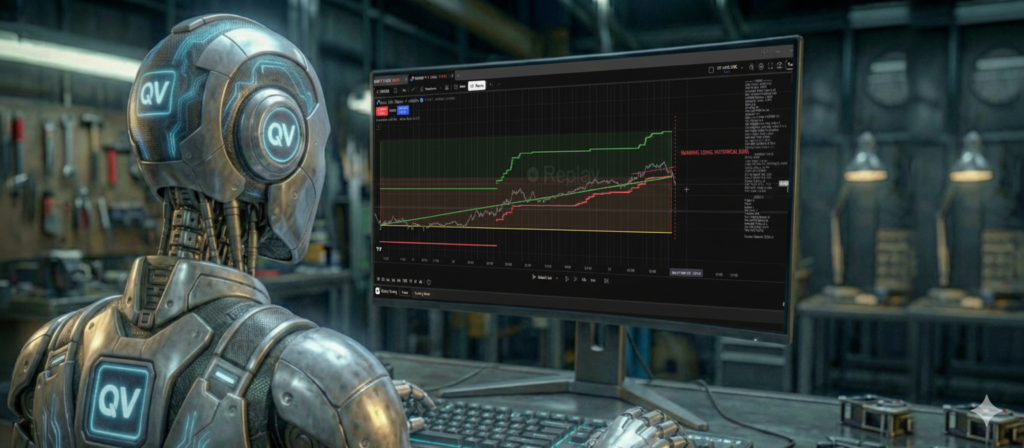
Welcome to the final installment of our “Mastering the Market” series. Throughout this series, we have dismantled the “Spaghetti Code” typical of retail trading tools and replaced it with a robust Trading Operating System. We have covered: 1. The Framework: Separating the “Brain” (Strategy) from the “Muscle” (Execution). 2. Risk: Dynamic position sizing that protects […]

Mastering the Market Part 6: Backtesting and Feedback—The “Glass Box” Advantage Read More »

Mastering the Market Part 5: QuantView’s Order Management—Bridging the Gap to the Broker

In Part 4, we explored how the QuantView Framework manages open positions to protect your capital. But before we can manage a trade, we have to open it. And this is where the theoretical world of the chart collides with the messy reality of the broker. If you have ever backtested a strategy that showed

Mastering the Market Part 5: QuantView’s Order Management—Bridging the Gap to the Broker Read More »

Mastering the Market Part 4: QuantView’s Risk Management—Protecting Capital After the Entry

In Part 3, we looked at how Time Emulation allows us to see the market with higher-timeframe stability while executing with 1-minute precision. Now, we arrive at the most critical phase of any trade: Management. Novice traders obsess over entries. They spend years tweaking indicators to find the perfect moment to buy. Professional investors know

Mastering the Market Part 4: QuantView’s Risk Management—Protecting Capital After the Entry Read More »

Mastering the Market Part 3: QuantView’s Time Emulation—Seeing the Future, Tick by Tick

In Part 2, we discussed how the QuantView Framework separates the “Brain” (Strategy) from the “Muscle” (Execution). Today, we are going to look at the engine that powers both: Time Emulation. If you have spent any time trading on platforms like TradingView, you are likely familiar with the “Timeframe Dilemma.” • The Granularity Problem: If

Mastering the Market Part 3: QuantView’s Time Emulation—Seeing the Future, Tick by Tick Read More »

Mastering the Market Part 2: What Makes QuantView Unique: The “Framework First” Advantage

In Part 1, we identified the “Spaghetti Code” problem: the tendency for retail trading scripts to mix entry signals, visual plotting, and risk logic into a tangled mess that is impossible to trust with real money. Today, in Part 2, we explore the solution: The QuantView “Framework First” Architecture. If you are a technical investor,

Mastering the Market Part 2: What Makes QuantView Unique: The “Framework First” Advantage Read More »

Mastering the Market Part 1: Why Your Strategy Needs an Operating System

Welcome to the future of retail trading. If you are a technical investor exploring the world of automated trading or Pine Script, you have likely encountered a familiar and frustrating scenario: You find a strategy that looks incredible. The backtest shows a steep, upward equity curve. The buy and sell arrows look perfect. You turn

Mastering the Market Part 1: Why Your Strategy Needs an Operating System Read More »

Scroll to Top