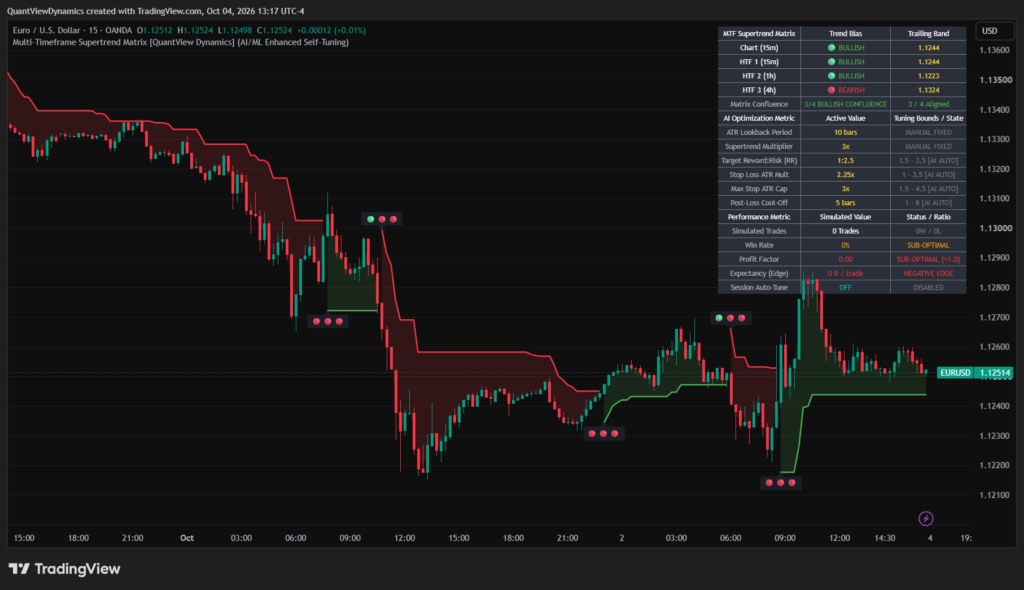
Master Multi-Timeframe Volatility: Multi-Timeframe Supertrend Matrix [QuantView Dynamics] (AI/ML Enhanced Self-Tuning)
Trading single-timeframe Supertrend indicators often leads to severe whipsaws during choppy, consolidating sessions. Retail traders routinely find themselves entering breakouts right into higher-timeframe resistance, only to get stopped out on sudden mean reversions. QuantView Dynamics addresses this core execution challenge with the Multi-Timeframe Supertrend Matrix (AI/ML Enhanced Self-Tuning). By synchronizing multi-timeframe volatility structures, enforcing macro-trend alignment, and deploying an autonomous Hill-Climbing parameter adaptation engine, this tool filters out market noise and pinpoints high-probability trend continuation entries.
Dynamic Volatility Bands and Series-Safe Math
Traditional Supertrend models rely on simple or exponential moving averages of Average True Range (ATR), which lag during abrupt volatility regime shifts or overreact to isolated outlier candles. The Multi-Timeframe Supertrend Matrix upgrades this core engine through an advanced mathematical framework:
- Multi-Mode ATR Smoothing: Users can toggle between SMA, EMA, WMA, Volume Weighted Moving Average (VWMA), or Volatility-Adjusted Wilder’s Moving Average (VAWMA/RMA). This ensures true volume-weighted or trend-reactive volatility modeling rather than generic lagging calculations.
- Outlier Deviation Capping: Extreme single-bar spikes—such as high-impact macroeconomic news releases—can artificially stretch volatility bands and distort risk-reward profiles. The engine features a built-in standard deviation filter (
st_max_dev) that caps runaway true range outliers to maintain realistic bands. - Non-Repainting Macro Ingestion: Macro trend alignment requests data across three discrete Higher Timeframes (HTF 1, HTF 2, and HTF 3) using non-repainting historical offsets (
lookahead = barmerge.lookahead_off, indexing bar[1]). This guarantees that every macro confirmation state is fully closed and locked in real time. - Closed-Bar Flip Verification: Rather than flipping bias on an intraday wick penetration, the algorithm requires consecutive closed bars beyond the band (
st_close_bars) before confirming an official trend flip, drastically suppressing stop-hunts.
Technical Strengths
- Hierarchical Confluence Gating: Enforces institutional macro alignment by verifying current chart flips against up to three higher timeframes simultaneously (4/4 Full Alignment or 3/4 Confluence).
- Self-Tuning Hill-Climber Engine: An active simulated trade tracking engine evaluates forward performance in real time. Following winning and losing trades, it dynamically steps Target R:R, ATR Stop Multipliers, Maximum Stop Distance Caps, and Post-Loss Cool-Off durations toward positive trade expectancy.
- Session Auto-Tune Candidate Grid: Evaluates an internal $3 \times 3$ grid (9 candidate combinations) of ATR lookback periods and multipliers across historical price data. On the latest bar, it identifies the top-performing geometric combination by simulated net R-multiple.
- Adaptive Post-Loss Cool-Off Protection: Prevents revenge-trading cycles by suppressing execution flips for a parameterized number of bars immediately following a simulated loss.
- Hard Volatility Caps: Prevents excessive risk allocations on oversized trigger candles by enforcing an ATR-multiple cap on initial stop-loss placement.
Applicability Across Trading Strategies
The matrix accommodates diverse trading horizons through its flexible alignment and execution parameters:
Scalping (1-Minute to 5-Minute Timeframes)
Scalpers navigating volatile intraday sessions should set the Multi-Timeframe configuration to fast structural anchors—such as the 5-minute, 15-minute, and 1-hour intervals. Setting the confirmation rule to Macro Confluence (3/4) allows rapid intraday execution while filtering counter-trend traps. Enabling the Post-Loss Cool-Off safeguards scalpers against rapid whipsaws inside tight opening-range consolidations.
Day Trading (15-Minute to 1-Hour Timeframes)
For intraday momentum setups on Forex majors and equity indices, configure HTFs to 1-hour, 4-hour, and Daily periods. Utilizing Full Alignment (4/4) ensures trades are only triggered when structural order flow across the entire macro stack agrees. Day traders can rely on the dynamic Supertrend trailing stop to lock in profits while riding extended intraday trend runs.
Swing Trading (4-Hour to Daily Timeframes)
Swing traders can anchor their primary chart to 4-hour or Daily bars while assigning HTF inputs to Daily, Weekly, and Monthly horizons. Utilizing the Supertrend Band stop mode provides structural breathing room, while the Session Auto-Tune locks into the historically optimal multiplier configuration for sustained multi-week movements.
Visual Presentation and On-Chart HUD
The indicator presents market structure without cluttering the execution window:
[Chart Display]
 ├── Green Trailing Band  ──> Bullish dynamic support floor
 ├── Red Trailing Band    ──> Bearish dynamic resistance ceiling
 ├── Shaded Trend Clouds  ──> Immediate directional bias
 ├── On-Chart Level Tags  ──> Precise Entry ("-"), TP ("-"), and SL ("-") marks
 └── Matrix Badges        ──> Macro State (🟢 🟢 🔴) or Cool-Off status (🔵)
- Dynamic Support/Resistance Lines: Plots green support levels below price during bullish phases and red resistance levels above during bearish phases.
- Directional Trend Clouds: Fills the space between price ($OHLC4$) and active Supertrend bands to immediately identify market regime.
- Entry and Target Dash Markers: Renders discreet yellow dashes at trade entry, green dashes at projected take-profit targets, and red dashes at stop levels on the trigger candle.
- Status Badges: Displays directional dot badges at every trend flip indicating exact HTF conditions (e.g., 🟢 🟢 🟢 for full alignment) or a blue badge (🔵) when a trade is actively suppressed by post-loss cool-off rules.
- Performance & Matrix HUD: An interactive on-screen dashboard displays real-time execution trend bias, HTF trailing band levels, composite alignment scores (e.g., “4/4 BULLISH ALIGNMENT”), simulated win rates, profit factor, total expectancy ($R$/trade), and active AI tuning values.
Settings Breakdown
Multi-Timeframe Configuration
- Higher Timeframe 1 / 2 / 3: Sets the three macro periods used for structural alignment (defaults: 15m, 60m, 240m).
Supertrend Volatility Engine
- ATR Averaging Mode: Selects the mathematical smoothing algorithm (SMA, EMA, WMA, VWMA, VAWMA).
- ATR Lookback Period & Multiplier: Controls baseline calculation period and band expansion multiplier.
- Max Outlier Deviation: Clamps extreme true-range volatility spikes when set above $0.0$.
- Closed Confirmation Bars: Number of closed candles required beyond the band to validate a trend flip.
Matrix Confirmation & Signal Rules
- Required Alignment Mode: Chooses execution filtering between Full Alignment (4/4), Macro Confluence (3/4), or Execution Flip Only (Unfiltered).
Simulation Targets & Stop Calculation
- Allow Concurrent Trades: Toggles whether secondary entries are accepted while an active simulated position is ongoing.
- Exit on Opposite Supertrend Flip: Forces an immediate position closure if the chart-level Supertrend reverses.
- Stop Loss Calculation Mode: Toggles between dynamic Supertrend Band trailing stops or pegged ATR Multiplier stops.
- Stop Loss ATR Multiplier & Max Initial Stop Cap: Sets baseline stop distance and the maximum protective cap based on 30-period ATR.
- Reward-to-Risk Ratio (R:R): Sets the baseline take-profit distance relative to risk.
AI / Self-Tuning Bounds
- Run Session Auto-Tune: Evaluates a 9-candidate parameter grid over historical data and pins the indicator to the optimal performer.
- Enable Self-Tuning Parameter Optimization: Activates the adaptive Hill-Climbing engine to tune R:R, stops, and cool-off bars after every resolved trade.
- Parameter Bounds & Step Sizes: Configures the operational search boundaries and incremental adjustment steps for ATR lookback, multiplier, R:R, stop-loss distances, and cool-off durations.
Systematic Evaluation
The Multi-Timeframe Supertrend Matrix resolves the single greatest flaw of volatility band trading: isolation from the macro trend. By coupling strict closed-bar confirmation with multi-tier timeframe confluence, it systematically eliminates the low-quality whipsaws that erode retail accounts.
The inclusion of an autonomous Hill-Climbing simulator provides objective feedback right on the chart. Rather than wondering whether a 3.0 multiplier or a 10-period lookback is appropriate for current market conditions, traders receive real-time, empirical readouts of win rate, expectancy, and profit factor.
QuantView Conversion Potential
This indicator is built from the ground up for systematic traders and algorithmic execution:
- Integrated Telemetry Plots: Contains dedicated, continuous telemetry plot channels for active stop-loss levels, profit targets, entry price, position direction, and boolean buy/sell signal pulses.
- Third-Party Webhook Compatibility: These hidden plots seamlessly map to TradingView alerts, enabling webhooks to route exact stop and target prices directly into automated execution software.
- State Machine Rule Enforcement: Built-in simulation trade structures (
ActiveSimTrade) model exact trade resolution states, preventing signal doubling and out-of-sequence order dispatching. - Non-Repainting Security Calls: The execution architecture references completed historical higher-timeframe bars (
lookahead_off, index[1]), ensuring backtest metrics match live forward execution without phantom fills.
Have you tested macro-trend matrix alignment across your primary trading pairs, or are you running standalone trailing bands? Share your backtest observations, charting configurations, and feature requests in the comments below!
All content, products, and opinions provided are for educational and entertainment purposes only and do not constitute professional financial, investment, or legal advice. We are not licensed financial advisors, and nothing herein is a recommendation to buy or sell any financial instruments. You assume full responsibility for your own financial decisions and due diligence, and we accept no liability for any losses or damages resulting from your use of this information.