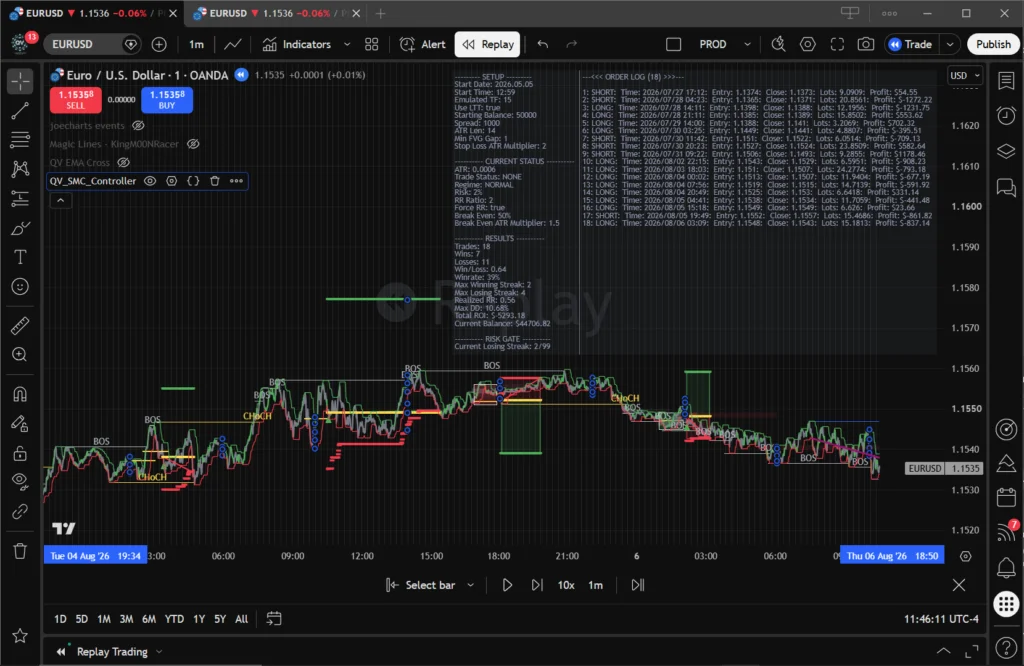
From Signal to Settlement: Institutional Order Shaping, Execution, and Active Trade Lifecycle Management
The Quick Answer: The single biggest barrier between a backtested strategy and real-world trading profitability is the Execution Chasm—the hidden performance drag caused by broker spreads, slippage, latency, and static trade management. By adopting an institutional trade lifecycle framework that actively shapes orders for spread parity, calculates volatility-adjusted lot sizing, and manages live positions with dynamic break-even buffers and regime-specific sliding stops, traders bridge this gap and protect their mathematical edge from entry to final settlement.
The Execution Chasm: Why Theoretical Edges Disappear in Live Markets
Every active trader knows the feeling: you analyze a pristine chart setup, identify a clear Smart Money Concepts (SMC) Order Block or Fair Value Gap, watch price react exactly as expected, and record a textbook win on paper.
Then you deploy real capital to a live brokerage account.
Suddenly, your net returns lag far behind your backtest. What happened? You collided head-on with the Execution Chasm.
┌────────────────────────────────────────────────────────────────────────┐
│                        THE EXECUTION CHASM                             │
│                                                                        │
│   THEORETICAL CHART SIGNALS                  LIVE BROKER REALITY       │
│   • Instantaneous fills                      • Bid/Ask Spread Drag     │
│   • Exact price touches                      • Slippage & Latency      │
│   • Static Risk-to-Reward (R:R)              • Dynamic Margin / Sizing │
│   • Zero transaction friction                • Unmanaged Open Retraces │
│                                                                        │
│        ════════════════════════════════════════════════════════        │
│          BRIDGED BY: SYSTEMATIC ORDER SHAPING & ACTIVE LIFECYCLE       │
└────────────────────────────────────────────────────────────────────────┘
In live markets, an entry trigger is not an isolated event; it is merely the first step in an end-to-end execution lifecycle. Between the millisecond a setup prints and the moment your broker fills your order, friction takes its toll.
If your approach treats order entry, position sizing, and trade exits as static afterthoughts, even an exceptional technical strategy will slowly bleed capital.
To bridge this chasm, professional traders approach execution through five distinct stages: Order Shaping, Deterministic Placement, On-Chart Telemetry, Dynamic In-Flight Management, and Clean Settlement.
1. Institutional Order Shaping & Structural Spread Parity
Before an order is ever routed to a broker, it must be systematically normalized rather than relying on raw chart coordinates.
┌────────────────────────────────────────────────────────────────────────┐
│                      THE ORDER SHAPING PIPELINE                        │
│                                                                        │
│   [ Raw SMC Signal: Order Block / FVG Entry ]                          │
│                          │                                             │
│                          ▼                                             │
│   1. Dynamic Risk Sizing       : Exact % allocation based on balance   │
│   2. Structural Spread Parity  : Offsets Entry to Ask/Bid Reality      │
│   3. Edge Preservation Gate    : Shifts SL/TP to protect target R:R    │
│   4. Spread Liquidity Guard    : Rejects setups if spread is excessive │
│                          │                                             │
│                          ▼                                             │
│   [ Spread-Adjusted, Mathematically Protected Execution Order ]        │
└────────────────────────────────────────────────────────────────────────┘
A. Dynamic Risk & Position Sizing
Fixed lot sizing is an amateur habit that exposes accounts to erratic risk profiles. Professional execution dynamically calculates exact position sizing based on real-time equity metrics:
$$ ext{Position Size} = rac{ ext{Account Balance} imes ext{Risk Percentage}}{ ext{Stop Loss Distance (Pips/Points)} imes ext{Point Value}}$$
This formula ensures that whether a setup requires an 8-pip stop on a quiet session or a 25-pip stop during high volatility, your account risk remains locked at your exact chosen parameter (e.g., 1.0% or 1.5%).
B. Structural Spread Management: Maintaining Mathematical Parity
Most chart setups display mid or bid pricing. When you initiate a long trade, however, your broker fills you at the Ask, starting your position with an immediate negative PnL equal to the spread:
- The Reality Check: Entering long at
1.10000with a 1.5-pip spread means your true entry is1.10015. Leaving your Take Profit at the original level shrinks your profit target while leaving your risk unchanged, degrading your reward-to-risk (R:R) ratio. - The Spread Parity Solution: A structured framework shifts both the Stop Loss and Take Profit levels outward by the spread offset. This maintains the precise mathematical edge designed into the setup.
- Edge Protection Filter: During low-liquidity rollover windows (such as late Asian session hours), spreads can widen significantly. An automated spread guard evaluates the current spread against the expected target distance, rejecting the trade before execution if transaction friction exceeds acceptable thresholds.
2. Real-Time Telemetry & On-Chart Trade Tracking
Once a position is live, maintaining visual clarity over active boundaries prevents emotional second-guessing and execution drift.
                  Dynamic Take Profit Target (Green)
  ────────────────────────────────────────────────────────── 1.10415
                              ▲
                              │ Trailing Trajectory
                              ▼
  ────────────────────────────────────────────────────────── 1.10015
                  Broker Fill Price (Yellow)
                              ▲
                              │ Risk Buffer Zone
                              ▼
  ────────────────────────────────────────────────────────── 1.09815
                  Active Stop Loss Boundary (Red)
Mapping broker-adjusted levels directly onto your workspace provides complete operational transparency:
- Fill Level (Yellow): Reflects the true broker execution price, accounting for spread.
- Active Boundary (Red): Tracks the protective stop loss as it tightens via break-even or trailing logic.
- Target Projection (Green): Represents the structural target, adapting dynamically if expanding channel rules are active.
- On-Screen Heads-Up Display (HUD): Delivers instant feedback on open risk, current R:R metrics, and trade duration.
3. Dynamic In-Flight Trade Management
Entering a trade is just the starting point. How you navigate open market volatility determines whether winning setups compound your capital or unravel into preventable losses.
┌────────────────────────────────────────────────────────────────────────┐
│                   IN-FLIGHT POSITION MANAGEMENT                        │
├────────────────────┬────────────────────┬──────────────────────────────┤
│ DYNAMIC BREAK-EVEN │   SLIDING STOPS    │    SESSION SAFEGUARDS        │
│ • Distance Trigger │ • Per-Candle Trail │ • Timed Stagnation Exits     │
│ • ATR Noise Buffer │ • Classic Ratchet  │ • Weekend Liquidation Guard  │
│ • Spread Offset    │ • Delayed Sliding  │ • Volatility Gap Protection  │
└────────────────────┴────────────────────┴──────────────────────────────┘
Volatility-Buffered Dynamic Break-Even
Prematurely moving a stop loss to exact entry price often leads to getting stopped out by routine retest wicks right before the market moves toward your target.
A professional approach uses an intelligent two-tier trigger:
- Milestone Distance: Price must complete a defined percentage of the journey toward the profit target (e.g., 50% or 60%) before break-even logic engages.
- ATR Noise Buffer: When activated, the stop is moved to entry plus an Average True Range (ATR) buffer. This absorbs normal market breathing and covers broker transaction fees, turning a scratch trade into a true net-neutral exit.
Multi-Regime Sliding Stops
Adapting your trailing exit mechanics to match the market environment is crucial:
- Classic Ratchet Mode: The stop loss tightens dynamically behind price while keeping the profit target static. This squeezes the trade into a quick, high-probability resolution—perfect for range-bound or mean-reverting conditions.
- Per-Candle Channel Mode: Both the stop loss and take profit expand dynamically candle-by-candle. This avoids capping profits prematurely during strong macroeconomic breakout expansions, allowing winning runners to capture outsized gains.
- Delayed Sliding Stops: Trailing stops remain dormant during the opening stages of the trade, giving the setup sufficient breathing room to develop structure before risk tightening begins.
Time-Based Risk Protections
- Timed Exits: Inactive consolidation traps margin. If a position fails to reach its target within a specified number of candles, the trade is automatically liquidated to redeploy capital into higher-probability opportunities.
- Weekend Liquidation Window: Holding positions over the weekend exposes accounts to geopolitical event gaps and Sunday opening spread spikes. An automated schedule liquidates open exposure ahead of Friday’s close to eliminate weekend risk entirely.
4. Deterministic Trade Settlement & Lifecycle Archival
A complete trade lifecycle demands a clean, emotion-free exit sequence that resets the workspace and captures execution data.
| Settlement Dimension | Amateur Set-and-Forget Approach | Systematic Lifecycle Framework |
|---|---|---|
| Order Closure | Discretionary panic-closing or static target touch. | Automated exit dispatch the moment an active boundary is reached. |
| State Reset | Trader fixates on past result; prone to revenge trades. | Immediate workspace reset; readies system cleanly for the next setup. |
| Trade Review | Vague memory of entry and exit reasons. | Clear visual trajectory lines and risk/reward overlays archived on chart. |
| Performance Tracking | Basic dollar PnL recorded in isolation. | Execution telemetry packaged for expectancy analysis and drawdown tracking. |
When an exit condition triggers, active dynamic lines transition into clean historical visual summaries:
- Risk & Reward Zones: Visual bounding boxes render across the lifetime of the trade, contrasting initial risk against realized excursion.
- Trade Trajectory Mapping: A direct vector connects the entry fill to the exit point, providing instant visual feedback on execution efficiency.
- Telemetry Packaging: Execution metrics (fill prices, trade duration, realized R:R) are cataloged to evaluate ongoing system health and expectancy.
For a deeper dive into the foundational architecture supporting this trade lifecycle, explore Part 1: Why Your Strategy Needs an Operating System, Part 2: The “Framework-First” Advantage, and Part 3: Time Emulation—Seeing the Future, Tick by Tick.
The Practical Takeaways for Active Traders
To elevate your execution from signal generation to institutional settlement:
- Compensate for Spread Friction at Entry: Never evaluate risk-to-reward on raw mid prices. Shift your stops and targets outward by the spread to preserve your statistical edge.
- Buffer Your Break-Even Levels: Replace flat break-evens with ATR-buffered offsets that protect against spread costs and market noise.
- Match Your Exits to the Volatility Regime: Use tight ratchets in ranging markets and expanding dynamic channels when trading high-momentum breakouts.
- Enforce Time-Based Risk Filters: Protect your margin by closing stagnant positions and eliminating weekend gap exposure ahead of Friday closes.
The Verdict
A profitable strategy is only as effective as the execution architecture that carries it across the live market.
By treating execution as an end-to-end discipline—shaping orders for real-world spread parity, actively managing in-flight volatility, and enforcing clean trade closure—you eliminate the execution chasm and ensure that your technical edge is faithfully realized on your bottom line.
Looking Ahead: Part 6 — Post-Trade Financials & Telemetry
In our next installment, we explore the final piece of the professional trading puzzle: Post-Trade Performance Analytics:
- Measuring Realized Risk-to-Reward (R:R) and True System Expectancy across large sample sizes.
- Dynamic Peak Equity tracking, Run-up analysis, and automated Drawdown Circuit Breakers.
- Tracking consecutive losses and enforcing algorithmic trading lockout safeguards.
Join the Discussion
How do you currently handle broker spread adjustments and active trailing stops in your trading setup? Do you use time-based session exits to avoid weekend gap risk?
Share your trade management rules and insights in the comments below!