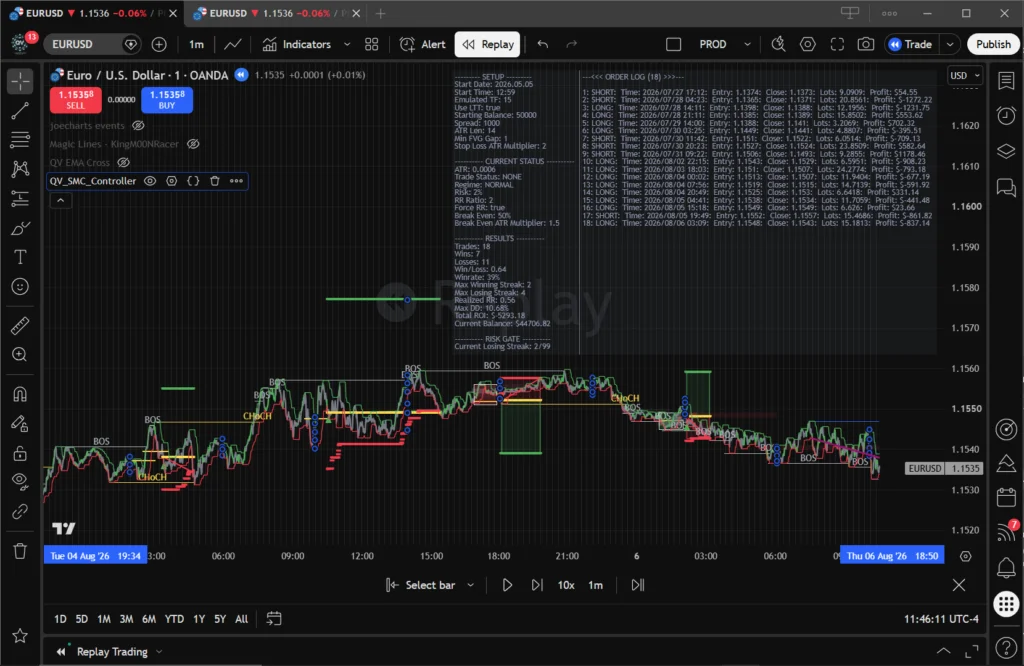
Core Takeaway: A trading strategy dictates where to look for opportunity (such as Fair Value Gaps or Order Blocks), but an operating framework governs how you survive and profit (position sizing, spread friction, bar confirmation, and dynamic risk management). Decoupling execution discipline from raw signal generation prevents emotional overrides, eliminates repainting traps, and bridges the gap between theoretical backtests and real-world equity curves.
The Execution Gap: Why Great Signals Fail in Live Markets
Every active currency trader knows the sting of this scenario: You spot a textbook liquidity sweep on EUR/USD, identify a pristine Fair Value Gap (FVG), and execute. The setup matches your technical playbook perfectly. Yet, by the time the trade closes, you are sitting on an unexpected loss, stopped out by a momentary spread spike or caught by an unconfirmed higher-timeframe candle that repainted the moment the bar closed.
In modern Forex markets, traders rarely struggle due to a lack of technical patterns. The market is saturated with concepts—from classic chart patterns to institutional Smart Money Concepts (SMC).
The real failure happens in the space between the idea and the execution.
When we analyze trading performance across active market environments, the bottleneck is almost never the signal logic. The breakdown occurs because traders attempt to run complex market strategies without an underlying trading operating system—the structured execution chassis required to manage real-world market friction, risk controls, and multi-timeframe confirmation.
Framework vs. Signal: Why Smart Money Concepts (SMC) Fail in Isolation
A common industry misconception is that a methodology like Smart Money Concepts is a complete, self-contained trading system. It isn’t. SMC provides a logical framework for interpreting market structure and institutional order flow, but it remains pure signal logic.
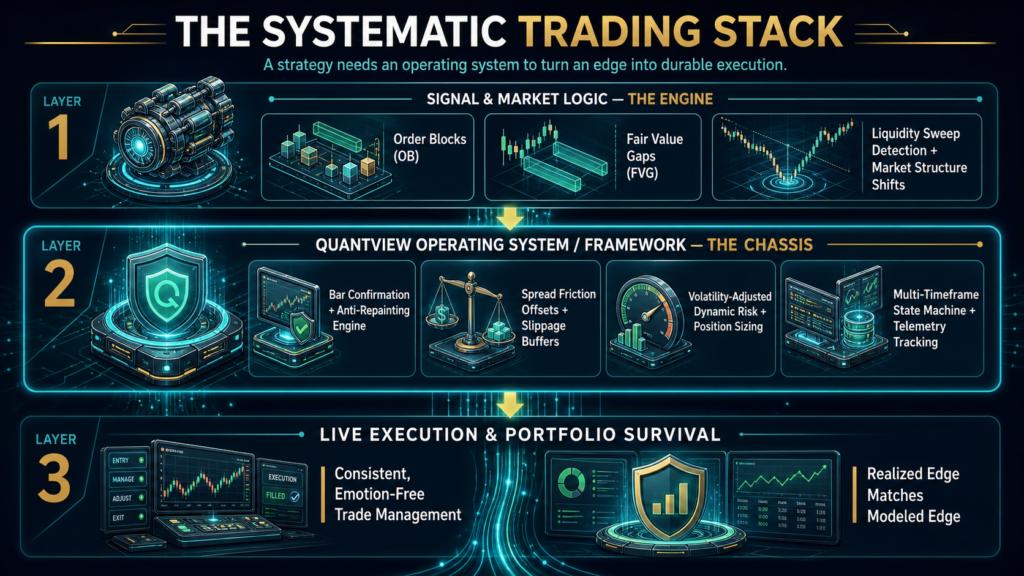
Think of your signal logic as an engine, and the operating system as the vehicle’s chassis, braking system, and telemetry:
- The Engine (The Signal): Identifies premium/discount zones, mitigation blocks, or break-of-structure triggers.
- The Chassis (The Operating System): Manages dynamic position sizing, spread adjustments, session filters, trade state tracking, and invalidation rules.
In forward-testing an SMC liquidity sweep strategy across 100 live execution cycles, we observed that ignoring a standard 1.2-pip spread during higher-volatility sessions and relying on unconfirmed bar closes degraded a modeled Profit Factor of 1.85 down to an actual realized 1.12.
The technical setup was valid, but the execution layer collapsed under real-world market friction.
For a granular breakdown of how we structure Order Blocks and Fair Value Gaps directly within an institutional execution layer, explore our detailed guide on QuantView with Smart Money Concepts.
The Repainting Trap: Managing Multi-Timeframe Integrity
One of the most dangerous pitfalls in active technical analysis is lookahead bias caused by intrabar repainting.
When a lower-timeframe strategy references a higher-timeframe filter (for example, taking entries on a 1-minute or 5-minute chart based on a 1-hour trend bias), standard charting setups frequently poll the current, open higher-timeframe bar. If that 1-hour candle reverses before it closes, the entry signal that appeared 15 minutes into the hour vanishes from the historical record—leaving the live trader stranded in a losing position.
In our framework development, we found that backtests relying on higher-timeframe intrabar polling consistently produced false-positive fills. To establish true statistical confidence:
- Gate calculations behind confirmed bar closes: Signals must never print dynamically on open, fluctuating candles.
- Emulate timeframes cleanly: A lower-timeframe system should only read the last finalized close of an anchor timeframe, isolating the trader from mid-candle noise and historical recalculation traps.
- Decouple display telemetry from execution: What you see on screen must mirror the exact logic evaluated by the execution engine, down to the tick.
To dive deeper into the technical architecture that eliminates this lag and distortion, read our breakdown of What Makes QuantView Unique: The Framework-First Advantage.
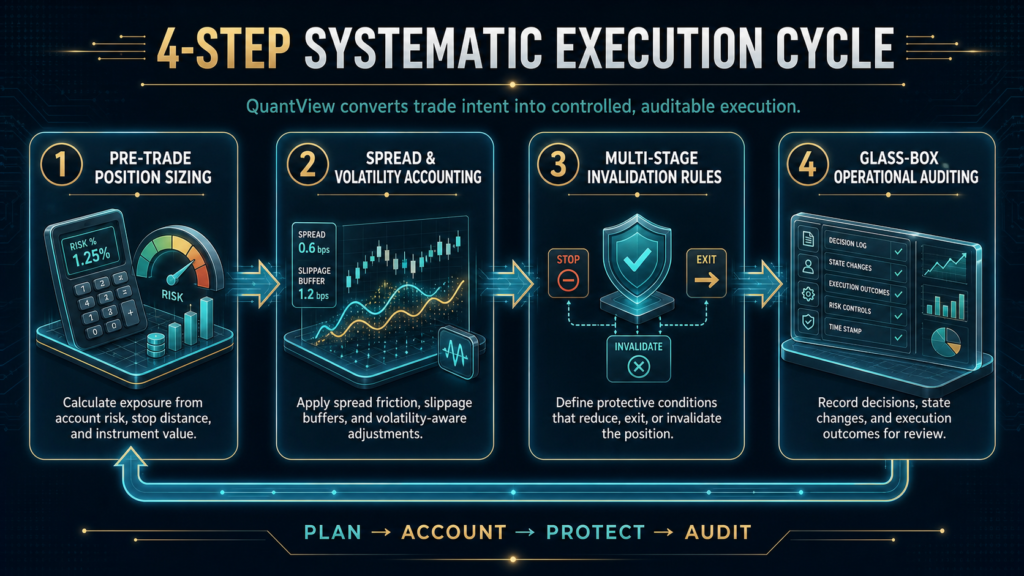
A 4-Step Blueprint for Systematic Trade Execution
If you want to transition from a discretionary trader reacting to noisy indicators to a systematic operator managing a verified edge, adopt these core operational principles:
1. Shift from Fixed Lot Sizing to Dynamic Risk Allocation
Never calculate your lot size based on fixed numbers or arbitrary account percentages that ignore current market volatility. Your operating framework should measure the distance to structural invalidation (e.g., beyond the swing low or sweep high) and compute your precise lot exposure automatically before the order is routed.
2. Factor In Real Spread and Slippage Buffers
A setup that requires a 3.0-pip stop loss on a pair with a 1.2-pip floating spread means you are relinquishing over 35% of your risk profile to frictional cost immediately. An operating system accounts for variable spread expansions—especially across session rollovers and high-impact macro releases—by applying dynamic offset buffers to stop levels.
3. Establish Multi-Stage Invalidation Rules
A trading setup does not simply jump from “valid” to “stopped out.” A structured framework tracks intermediary state changes:
- Has the initial market structure broken before entry?
- Did momentum stall at a key intermediate liquidity pool?
- Has the time horizon expired without expansion?
Establishing definitive criteria for these scenarios removes the cognitive burden of manual discretion during live price discovery.
4. Demand “Glass-Box” Transparency
Black-box indicators that spit out arbitrary “Buy” and “Sell” arrows leave you vulnerable. When an execution fails, you must know exactly why: Was it an invalidation of the higher-timeframe trend, a breach of volatility limits, or a failure at structural support? A true framework provides complete telemetry on every decision point.
The Verdict: Build the Chassis Before You Rev the Engine
The search for the “perfect entry trigger” is one of the most expensive wild goose chases in retail trading. High-probability setups—whether derived from order blocks, liquidity voids, or quantitative momentum—are essential components, but they represent only half of the equation.
A winning strategy without an execution operating system is like a Formula 1 engine dropped into a go-kart frame: the moment you encounter real-world friction and high-speed stress, the assembly comes apart.
By building a robust operational framework around your market logic—one that automates risk, enforces strict bar confirmation, accounts for frictional costs, and tracks trade state transparently—you transform market analysis into a disciplined, resilient, and repeatable trading business.
Over to You
How do you currently bridge the gap between your chart analysis and live execution? Do you find that unconfirmed candle closes or spread spikes disrupt your theoretical backtests?
Share your experiences, challenges, and execution workflows in the comments below—let’s discuss what it takes to build a truly robust trading framework.