Inside the Engine Room: A Hands-On Guide to QuantView with Smart Money Concepts
A flawless chart setup does not guarantee a profitable trade. Retail traders spend hours mapping institutional market structure, marking pristine Fair Value Gaps (FVGs), and identifying textbook Order Blocks (OBs)—only to stumble during live market execution. Hesitating at the trigger, miscalculating lot sizes under pressure, and manually tampering with stop-losses remain the most common reasons well-analyzed setups fail.
QuantView with Smart Money Concepts (SMC) bridges the gap between passive technical analysis and systematic execution. By pairing advanced structural detection with an automated risk and execution engine, it transforms your chart into an institutional heads-up display (HUD) that handles position sizing, spread parity, and active trade management without emotional interference.
+-------------------------------------------------------------------------+
|                  QUANTVIEW TWO-TIER OPERATING MODEL                     |
+-------------------------------------------------------------------------+
|  [ MARKET LOGIC ENGINE ]                                                |
|  * Structural Shift Detection (BOS / CHoCH)                             |
|  * Unmitigated Order Block & FVG Tracking                               |
|  * Emulated Multi-Timeframe Alignment                                   |
+-------------------------------------------------------------------------+
                                    | (Raw Setup Request)
                                    v
+-------------------------------------------------------------------------+
|  [ EXECUTION & RISK FRAMEWORK ]                                         |
|  * Dynamic Position Sizing (% Equity / ATR Buffer)                      |
|  * Real-Time Spread Parity Adjustment (Bid/Ask Offsets)                 |
|  * Active Lifecycle Control (Break-Even, Trailing Ratchet, Session Gate)|
+-------------------------------------------------------------------------+
The Dual-Layer Architecture: Brain vs. Muscle
Most trading tools merge setup identification with trade execution into an opaque script. QuantView separates these tasks into two dedicated layers: the Market Logic Engine and the Execution Framework.
+------------------------+---------------------------------------------------+
| System Layer           | Primary Operational Responsibilities              |
+------------------------+---------------------------------------------------+
| Market Logic Engine    | * Continuously scans multi-timeframe price action |
| (The Brain)            | * Flags liquidity sweeps and mitigation targets   |
|                        | * Issues structured setup parameters              |
+------------------------+---------------------------------------------------+
| Execution Framework    | * Calculates exact lot sizing to the cent         |
| (The Muscle)           | * Adjusts entries and stops for broker spread     |
|                        | * Manages trailing stops and circuit breakers     |
+------------------------+---------------------------------------------------+
1. Signal Staging & Institutional Structure
The Logic Engine scans rolling higher-timeframe windows to track swing points, market-structure breaks, and supply/demand imbalances. When price revisits an unmitigated Order Block, the system generates an actionable, rules-based entry order rather than a vague visual clue.
2. The Spread & Risk Buffer
Before an order stages, the framework intercepts the setup. It calculates precise lot sizing based on your predefined risk threshold (e.g., 1.0% of total equity) and volatility parameters. It automatically widens entry and stop boundaries to account for live broker spreads, preventing hidden transaction costs from skewing your net reward-to-risk ratio.
3. Active Trade Lifecycle Management
Once an order fills, execution rules govern the position across every tick:
- Cost-Covering Break-Even: Shifts your stop-loss past the entry threshold once a specific target milestone is secured, locking in spread and commission costs.
- Dynamic Profit Ratchets: Deploys systematic trailing stops—such as per-candle structural trails or volatility-based ratchets—to defend open profits during sustained trends.
On-Screen Telemetry: What You See on the Chart
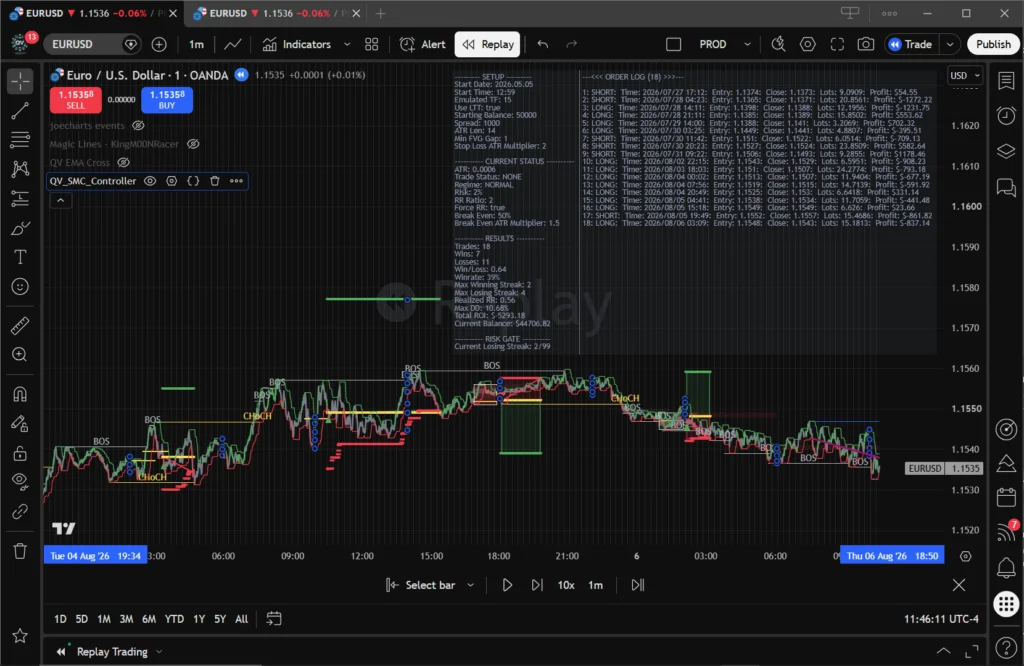
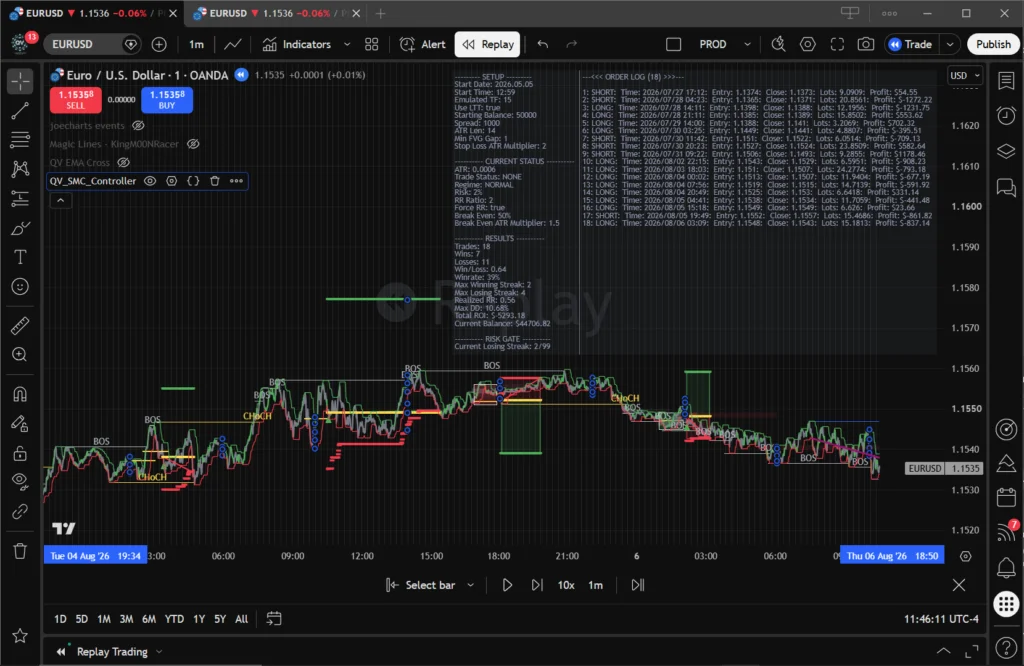
Operating with systematic clarity requires complete visibility. QuantView replaces cluttered indicator overlays with a clean operational dashboard:
- Visual Order Geometry: Active Order Blocks, liquidity levels, and Fair Value Gaps render with defined price boundaries. Closed trades display a direct vector connecting the exact fill to the final settlement point, color-coded green for profit and red for loss.
- Live Performance HUD: An on-chart dashboard tracks real-time account health, including live equity, win rate, realized R:R, active market regime (Volatile, Normal, or Trendy), and current peak-to-trough drawdown.
- Automated Risk Circuit Breakers: If consecutive losses breach your predetermined threshold, the system enforces a cooldown lockout, blocking new executions during unfavorable market conditions.
Customizing the Engine to Your Trading Plan
No two traders share identical risk profiles or operational schedules. QuantView provides flexible settings to align with your personal trading plan:
- Dynamic Capital Sizing: Set static percentage-based equity risk per trade, or enable regime-adaptive scaling to expand target sizes during clean trend structures.
- Stop-Loss Architecture: Choose between volatility-buffered stops based on Average True Range (ATR) or strict structural swing points.
- Sliding Stop Profiles: Toggle between a tight per-candle trailing stop for aggressive intraday scalping or a wide dynamic ratchet for multi-session swing setups.
- Multi-Timeframe Filtering: Emulate higher-timeframe structures (e.g., 15-minute or 1-hour blocks) directly on your execution chart to filter out lower-timeframe noise.
Practical Takeaways for Active Traders
- Eliminate Sizing Fatigue: Hardcode fixed risk parameters so you never have to manually calculate lots during fast-moving market opens.
- Account for the Spread Gap: Ensure all historical testing and live setups factor in transaction costs before determining your target R:R.
- Automate Trade Exits: Remove discretionary emotion from trade management by relying on systematic break-even triggers and trailing ratchets.
The Verdict
QuantView with Smart Money Concepts replaces emotional guesswork with an institutional workflow. By decoupling market analysis from execution and embedding rigorous risk controls directly onto your chart, it provides the transparent infrastructure required to run your trading as a disciplined business.
Which phase of your execution workflow—position sizing, spread protection, or post-entry trade management—presents the biggest hurdle in your live trading?