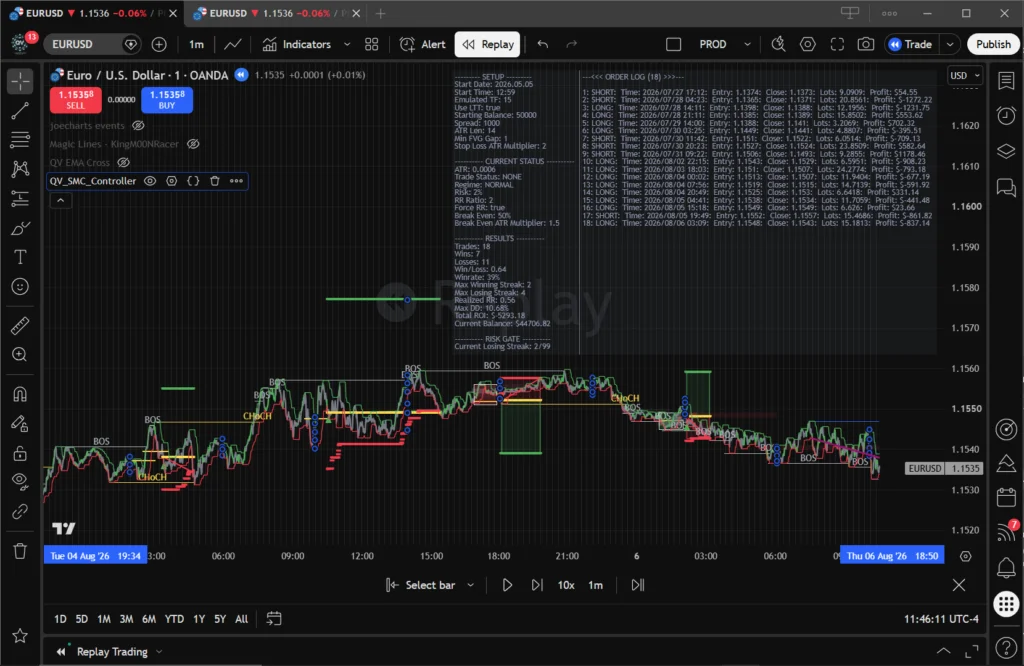
The Quick Answer: The number one reason promising trading strategies fail in live markets is rarely the entry trigger—it is the execution architecture. When entry indicators are forced to calculate position size, enforce stop losses, and navigate session liquidity on the fly, execution breaks down. By decoupling your trading approach into a dedicated Strategy Layer (The Brain) and an autonomous Execution Framework (The Muscle), you safeguard capital with systematic risk controls, eliminate execution errors, and ensure institutional-grade consistency across any market environment.
The Fatal Flaw of the “All-in-One” Trading Setup
Every active trader knows the feeling: you spend hours tuning a moving average crossover or an RSI pullback setup on a 15-minute chart. The visual signals look crisp, the backtest looks promising, and you decide to take it live.
Then reality hits.
A high-impact news event blows through your manual stop. A signal fires in the dead of the late Asian session when spreads are wide and liquidity is non-existent. You take a full-size position on an unusually volatile day, only to realize that a normal market retracement wiped out 6% of your account instead of your planned 1.5%.
In the retail trading world, this breakdown happens because most setups force the entry indicator to act as the entire trading system. When your setup logic, chart visuals, order routing, and risk parameters are tangled into one monolithic process, you don’t have a resilient strategy—you have a fragile house of cards.
If you want consistency across market regimes, you must separate what you see from how you execute.
The “Brain vs. Muscle” Framework
To build an enduring edge in modern Forex and macro trading, professional desks treat strategy and execution as two distinct operational layers.
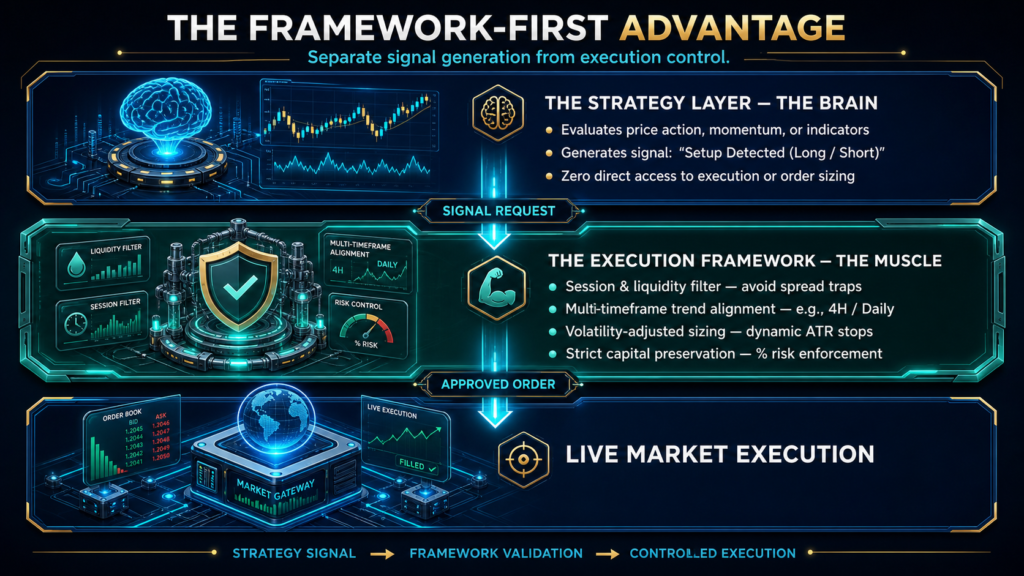
1. The Strategy Layer: “The Brain”
The Brain has one isolated objective: identify high-probability price imbalances or momentum shifts.
Whether you are trading a classic Moving Average Crossover, an RSI divergence, or a structure breakout, the Brain’s logic remains intentionally lightweight. It scans market structure and raises a single conditional flag: *”A technical setup is present.”*
Crucially, the Brain has zero authority to fire live market orders. It cannot choose your lot size, and it cannot risk your capital. It merely passes an intent request downstream to the execution framework.
2. The Execution Framework: “The Muscle”
Once a trade signal is submitted, the Framework acts like a dedicated risk desk standing between your indicator and the market. Before a single dollar is placed on the line, every trade must pass through an institutional-grade gauntlet of objective filters:
- Session & Context Verification (The “When”): Validates whether market conditions actually support execution. Is the setup occurring inside an active, liquid trading session (e.g., London/New York overlap), or during the dead hours where rollover spreads eat your margin?
- Multi-Timeframe Trend Alignment (The “Direction”): Calculates broader macroeconomic structure independently on higher timeframes (such as the 4-Hour or Daily chart). If the macro trend is firmly bearish, a short-term 5-minute buy signal is rejected on the spot.
- Dynamic Volatility & Position Sizing (The “How Much”): Fixed lot sizes are a fast track to account drawdown. The Framework reads real-time market volatility via the Average True Range (ATR), dynamically places protective stop levels outside market noise, and reverse-engineers the precise trade size to ensure your risk never exceeds your pre-set threshold (e.g., 1.5% or 2.0% per trade).
Why Modularity Wins: The Power of Strategy Swapping
What makes a framework-first mindset transformative for active retail traders?
| Execution Dimension | Monolithic / Indicator-Driven Setup | Modular “Framework-First” Approach |
|---|---|---|
| Risk Enforcement | Manual calculation or static lot sizes; prone to emotional overrides. | Dynamic, ATR-based math locking exact account risk percentage per setup. |
| Market Regime Changes | Swapping strategies requires rebuilding risk parameters from scratch. | “Plug-and-play” agility: change the entry signal while keeping proven risk logic intact. |
| Session Discipline | Easy to take low-liquidity or off-session signals during screen fatigue. | Programmatic context filtering blocks out-of-session entries automatically. |
| Auditability & Logging | Unclear why a trade failed (bad signal vs. bad sizing). | Complete visibility into why trades were accepted, filtered, or sized. |
When your execution framework is rock solid, you unlock true strategy agility. You can trade a trend-following momentum model on EUR/USD today, shift to a mean-reversion setup on GBP/JPY tomorrow, or test a Smart Money Concepts structure next week. Because your “Muscle”—the engine managing position size, multi-timeframe confirmation, and risk parameters—remains completely intact, your account stays protected by the exact same institutional safeguards.
For a deeper dive into the foundational architecture required for institutional-grade trading, explore Part 1: Why Your Forex Trading Strategy Needs an Operating System or see how this works in real-time execution in Part 3: QuantView’s Time Emulation—Seeing the Future, Tick by Tick.
The Practical Takeaway for Active Traders
To build a repeatable trading career, stop asking technical indicators to do jobs they were never engineered to handle.
- Keep Your Triggers Lightweight: Let your entry rules focus exclusively on finding market edges, momentum, or structural inflection points.
- Standardize Your Execution Gauntlet: Never enter a trade without passing it through three objective gates:
- Context Gate: Is liquidity sufficient right now?
- Trend Gate: Does higher-timeframe order flow agree with this entry?
- Sizing Gate: Is this position size mathematically tied to current market volatility (ATR) and a fixed account risk limit?
- Decouple the Decision from the Mechanics: When your risk management operates autonomously, emotion and execution drift disappear.
The Verdict
In modern Forex and financial markets, profitability is rarely won on a secret indicator combination—it is won through capital preservation and execution discipline.
By adopting a modular, “Framework-First” philosophy, you build an unshakeable barrier around your trading account. You allow your strategy layer to hunt for opportunity with clarity, while your execution layer guarantees you survive long enough for statistical edge to compound.
Join the Discussion
How do you currently handle risk sizing and session filtering across your active setups? Are you still relying on manual lot sizes, or have you implemented dynamic, volatility-based risk rules?
Share your workflow, trade management rules, and feedback in the comments below!