The Entry Is Just the Invitation: Why Elite Traders Obsess Over Position Management
The Quick Answer: Novice traders spend years obsessing over the “perfect” entry trigger, but long-term profitability is determined after the order is filled. Static “set-and-forget” stops leave capital vulnerable to sudden reversals and commission drag. By deploying systematic Position Management—such as volatility-buffered break-even triggers and adaptive trailing stops (Classic Ratchet vs. Per-Candle Channel)—traders protect open profits, eliminate transaction-cost drag, and capture outsized trend runs with zero emotional interference.
Moving Beyond the “Set and Forget” Illusion
In our previous deep dive on Time Emulation and Rolling Windows, we explored how decoupling your base chart from analytical time frames delivers macro trend stability with micro execution agility. But once your order is live in the market, an inescapable reality sets in:
The entry is merely an invitation to the dance. Whether you leave with profit or a bruised account balance depends entirely on how you manage that trade while it is open.

The retail landscape is filled with traders who treat trade execution like a coin flip: place an entry, drop a fixed stop loss and a static target, and walk away. But institutional market participants know that market conditions evolve dynamically with every tick.
If your trade management stays static while volatility shifts, you surrender control over your risk-to-reward profile.
Active Trade Management: Protecting Capital Tick by Tick
A professional trade management framework treats execution as an ongoing, active discipline rather than a one-time event. Once an order is open, real-time risk controls must monitor price action to lock in gains and defend account equity.
1. The True Break-Even Protocol: Accounting for Friction
One of the most psychologically liberating milestones in any trade is reaching “break-even”—moving your stop loss to entry so you cannot lose money on the setup.
However, naive retail setups almost always get this wrong:
- The Naive Approach: Moving your stop strictly to the exact entry price. In the live market, once you factor in spreads, slippage, and broker commissions, a price tag that hits raw entry actually logs a net loss on your statement.
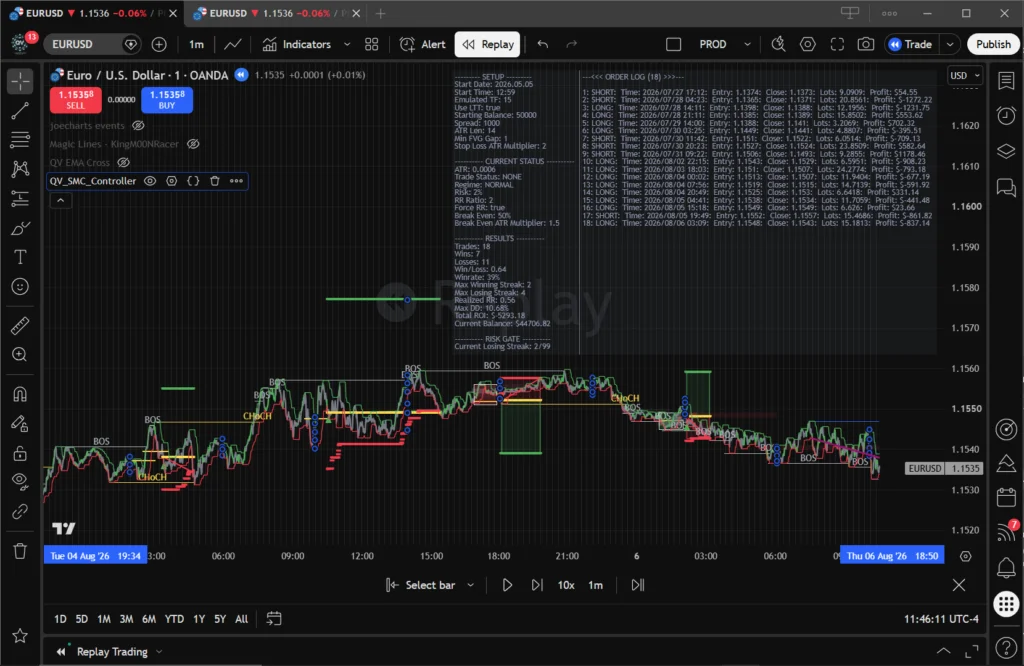
- The Volatility-Buffered Approach: A professional framework applies a dynamic Profit Buffer—often scaled via the Average True Range (ATR)—that advances the stop slightly beyond your entry level. This guarantees that when a trade is scratched, transaction fees and broker friction are fully absorbed, converting the exit into a true, net-neutral event.
Classic Ratchet vs. Per-Candle Dynamic Channels
Once a trade runs into green territory, active traders face the classic psychological dilemma: Do I close early and risk leaving massive gains on the table, or do I hold on and watch my open profit evaporate into a pullback?
Systematic trade management eliminates this anxiety by using two distinct sliding stop mechanisms tailored to specific market regimes:
| Management Mode | Core Mechanism | Target Behavior | Best Market Regime |
|---|---|---|---|
| Classic Trailing (The Ratchet) | Moves stop loss upward at a fixed ATR distance behind price; never loosens. | Fixed Target: Keeps the initial Take Profit static, squeezing price into a quick resolution. | Range-bound markets, scalping sessions, and rapid mean-reversion setups. |
| Per-Candle (The Dynamic Channel) | Advances both Stop Loss and Take Profit levels as each new candle forms. | Expanding Target: Pushes the target outward with momentum rather than capping gains. | Strong trend-following regimes, macro breakout expansions, and runner trades. |

Deploying the Right Tool for the Market Regime
- Use the Classic Ratchet when volatility is choppy or contained within major support and resistance boundaries. By locking your take profit while ratcheting the stop, you extract a high-probability slice of the move before the inevitable range retracement.
- Use the Per-Candle Channel when trading high-conviction macroeconomic momentum or breakout expansions. By allowing your take profit to expand dynamically alongside price action, you stay in winning positions longer and capture the outsized “home run” moves that define professional track records.
To see how dynamic position management integrates with modular strategy design and multi-timeframe confirmation, revisit Part 1: Why Your Strategy Needs an Operating System and Part 2: The “Framework-First” Advantage.
The Practical Takeaways for Active Traders
To take the emotional burden off your shoulders and transform your trade management:
- Eliminate Naive Break-Even Orders: Never anchor a stop loss to your exact entry price. Always include a volatility buffer to cover broker commissions, spreads, and execution friction.
- Align Your Exit Mechanics With Market Context: Match your trailing logic to the environment. Squeeze range trades with fixed targets, and let trend trades breathe using expanding dynamic channels.
- Automate the Discipline: When your exit rules are governed by strict mathematical logic rather than mid-trade panic, execution drift disappears and long-term expectancy compounds.
The Verdict
A mediocre entry executed inside an institutional-grade management framework will consistently outperform a flawless entry managed with emotion and static rules.
By standardizing your break-even protocols and employing regime-specific sliding stops, you protect your hard-earned equity, eliminate trading friction, and let mathematics guide your profitability.
Join the Discussion
How do you currently handle active trades once they move into profit? Do you prefer locking in targets with a tight trailing ratchet, or do you let your winners ride using dynamic, candle-by-candle channels?
Share your trade management rules and insights in the comments below!